- Home
- Live
- Departments
- Public Works
- Street Maintenance
- Traffic Signs and Signals
Traffic Signs and Signals
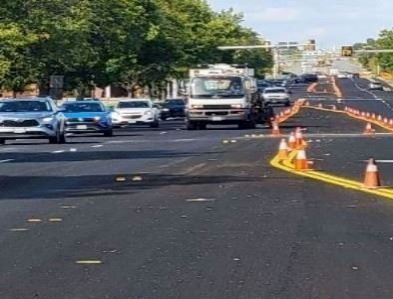
Signs and Pavement Markings
Traffic Signs
Sign fabrication, installation, and maintenance for traffic signs are done in-house in "the sign shop" at Traffic Operations. Throughout the year, the traffic crews are responsible for maintaining approximately 11,731 signs. These include speed limit signs, STOP signs, and street name signs.
Pavement Markings
The Traffic Division paints approximately 180 lane miles of roads per year using 25,000 gallons of paint. Crews also maintain about 760 crosswalks, 267 miles of street centerlines annually, pavement marking arrows, railroad markings, and red curbs.
The Traffic Division uses environmentally-safe latex paint for traffic marking. Using a water-based (latex) paint decreases hazardous waste generation, requiring only soap and water for cleanup.
Traffic Signals
Timing and Coordination Program
The Traffic Signal Timing Team is made up of the City's Traffic Engineer and technicians who specialize in the timing and coordination of the traffic signals. The Signal Timing Team gathers data, evaluates, and studies the major and minor arterial streets. They drive the arterial before and after the new coordination timing is applied to determine the effectiveness and efficiency of the new coordination.
How Traffic Signals are Coordinated
Coordinated signals attempt to provide green lights for the major vehicle flow on a street. This requires that City staff gather data on the volume, speed, distance between signals, and the timing of individual intersections. When the data has been collected, a study is done to determine the best timing and coordination of all intersections involved. This may require that the timing of the intersections be adjusted to facilitate the best flow of vehicles.
When the best coordination has been determined the Traffic Signal Timing Team implements the new timing. Studies are conducted to evaluate the efficiency and to make needed adjustments. Coordination throughout the city is continually monitored and is reevaluated as needed.
2023 Traffic Control Inventory
- 98 Traffic Signals
- 25 School-Related Pedestrian Crossings
- 22 Non-School-Related Pedestrian Crossings
- 1 Fire Signal
- 82 School Flashers
- 57 Speed Radars
- 342 Illuminated Street Name Signs
- 719 City-Owned Street/Parking Lot Lights
You can report a downed traffic signal or sign by submitting our Streets Inquiries or Concerns online form.
- Why do traffic lights take so long to change?
-
Every signalized intersection has special coordination needs and may require various types of timing depending on a few factors such as traffic volume, speed, direction of travel, time of day. Specific questions about a traffic signal can be directed to the Broomfield Traffic Engineer at traffic-engineering@broomfield.org.
- Why does a signal change when no vehicles are present?
-
If a signal is changing with no vehicles present, an error with our detection cameras may be occurring. Please contact the Streets Division using this form.
- Why aren’t signals put on a flash cycle late at night?
-
Broomfield does not put signals in flash overnight in order to maintain a more typical condition for vehicles at the intersection over the entire day. One of the main goals is consistency in traffic signals and this helps us achieve this. Overnight signal timing is changed so that they are no longer in coordination to assist drivers in getting a green as soon as possible.
- When traveling on some streets, red lights are hit on a regular basis? Can't they be coordinated?
-
All of Broomfield's signals are coordinated along the major roadways. Coordination is based on which roadway is the larger roadway classification, directional traffic, and distance between signals.
- Why isn't there enough green time at a signal to get the traffic through at some approaches?
-
The goal is to have enough green time to clear traffic at all times. During peak times the coordinated roadways which have higher traffic volumes are typically prioritized to move more traffic through the intersection. Some approaches or turn movements may have more delay as a result.
- Who takes care of state highways and traffic lights?
-
The Colorado Department of Transportation (CDOT) is responsible for all street surface repairs and maintenance including potholes, snow control, and weed mowing and for signal maintenance/timing on state highways within Broomfield's city limits including Hwy 121, Hwy 128, Hwy 287 (a.k.a. Wadsworth Boulevard), 120th Avenue, and Hwy 7, Please contact CDOT directly with any questions or concerns.